Posts from the “Advertising” Category

Because

JJuice cause

If you have raised a child there is an encounter you are sure to have dealt with. It is the incessantly curious moment.

It is that exchange where every statement you make is met with, “Why?” And after which, each subsequent explanation is met with another, “Why?” And so on. Why? Why? Why?

At some point the exasperated parent blurts out the one word to end all conversation:

“Because!”

“Because.” It is an interesting word. The verb “to be” combined with the verb “to cause”. Or as the old French roots would describe: “by reason of.”

“Because!”

I spend much of my professional life trying to figure out the “because” of things, specifically, the “because” of human thinking and behavior … the “becauses” of thinking a certain way, voting a certain way, giving to a certain institution, joining a certain, dare I say, “cause.”

One thing you quickly discover. Correlation is not cause. It is easy to determine correlation. That is, being able to show that if “this” happens it is very likely “that” will happen around the same time. This is most of the research you see. We sift through the numbers and we see correlations between one phenomenon and another. We even ascribe percentages to it. When this occurs or we take action “A”, then 12% of the time they open the email. But when we do something else and take action “B”, then 16% of the time they open the email. So we show correlation. But was the different action “B” the “be” “cause” of the 4% difference? It is very hard to know.

A long time ago there was a guy named Aristotle. He came up with four ways to think about or look at “causes.” A couple thousand years later, Aristotle’s approach still has value when we think about identifying “cause” in politics, marketing, and social change.

First, there is the material cause. This was the cause determined by the “material that composes the moving or changing of things.” This is the easiest of “causes” to observe and perhaps the most simplistic. It is also the least meaningful. A window broke because a rock went through it. Broken window. Cause = rock. A car engine quit because it ran out of gas. Immobile car. Cause = no gas.

You could say they “caused” the window to break and the car to stop. But were simply materials. They don’t “do” anything. They just enabled something.

It is exactly the same when we ascribe societal or behavior change as the result of a device (iPhone) or an app (GoogleMaps) or a service (Amazon). We say these things are change agents. To be sure change has happened “because” of these things. But they are only a material cause and only give a shallow answer to the “be” “cause” of change.

Second, Aristotle spoke of a “formal” cause. The formal cause results from the arrangement of things. Good examples are the harmonic of a particular musical scale that produces a pleasant sound or the algebraic formula that “causes” an arch to support weight.

Now this gets a bit more interesting. We see it in everyday life. We pay a lot of attention to the “position” of a product or service, whether it is in the supermarket or on a Google search page. Why? Because the “formal cause” or arrangement of things changes an outcome. If you’re selling something you want it to be at the end of the aisle. We pay to have our search term higher up on a page. Yes, these marketing formulas for change work, however often we’re not exactly sure why.

Let’s go further.

Third is Aristotle’s “efficient” cause. This was the cause prompted by a person or change agent. The artist Michaelangelo was the “efficient cause” of the Pieta. You might even say that Hitler was the “efficient cause” of World War II.

Again, we see parallels in assessing the “be” “cause” of developments in business and politics. Einstein. Edison. Jeff Bezos. Elong Musk. Barak Obama. We ascribe to them all manner of causes and changes in politics, society and business. Efficient cause goes beyond substance (the rock or gallon of gasoline), beyond form (the harmonic or equation) to the person or persons who were able to imagine and effectuate change.

Applied to everyday communications, the efficient “cause” are the influencers, the early adopters, the activists, networks and communities that can either make something relevant or irrelevant. So we identify the change agents and chase after them.

Finally there is Aristotle’s – well – “final” cause. This was the ultimate cause. It was and remains the most controversial. It is the cause that is determined by the intrinsic purpose and nature of a particular thing, event or being. As described (in Wikipedia!) it is the cause prompted by “the purpose for which things became.”

Now that’s a phrase to chew on.

Finding the “final” cause of things is the most difficult (and dangerous) but not surprisingly it is the one I find most fun and rewarding. It is finding the “be” “cause” of thinking and action that is due to the intrinsic nature of a person’s being and doing. We talk about it at our agency as the relevant cause. It is looking at things through the eyes, hearts and minds of people and trying to make sense out of the “why” of their attitudes and behavior. And while there, to sift through all the complexity and find out those relevant cause(s) for action.

So the conversation with the little child never ends. After every statement, phenomenon, action, event, or campaign comes the inevitable question: “why?” If we can answer the “why” and find the (be) cause behind those things, we are wiser and can make better decisions about things in the future.

Why?

Well … because!

Smug

When I first saw this I was with my wife and our friend Denise was over at our house.  When the commercial ended, Denise said bluntly “What was that?!?”

When I saw it again I had the same reaction.  And I guess a lot of others have as well.  GM executives have had to go to great lengths to defend it.  GM’s advertising director Craig Bierley says that the piece has been “misperceived.”  I don’t think so.

Why the uproar?

Well let me tell what does not upset me.

I’m not upset about the ad’s American exceptionalism and the dig on the “other countries” that take long vacations or enjoy cafes.  That’s been around for a long time.  My wife was European (now American).  We’re used to the jabs back and forth.

I’m not upset about the ad’s continued promotion of the American “myth” that if you work hard, play by the rules and gut it out everything will be ok … that you’ll end up with a beautiful spouse, adoring children and a house with a pool in Malibu.  The actor even says definitively “it’s that simple.”  Of course it isn’t simple.  More importantly it isn’t true.  For every Horatio Alger success story that you give me I can personally introduce you to one or two people who have done all of what they have (and more!) and are poor, struggling, and need help.  But again, I’m used to that.

And I’m not upset about the ad’s blatant consumerism.  In her searing piece in the Huffington Post, Carolyn Gregoire writes:

The opening shot shows a middle-aged man, played by the actor Neal McDonough, looking out over his backyard pool, asking the question: “Why do we work so hard? For this? For stuff?”  As the ad continues, it becomes clear that the answer to this rhetorical question is actually a big fat YES.

But consumerism and advertising have long been married.  So nothing new there.

No, what upsets me about the ad is the attitude it embraces and, indeed, celebrates which can best be summed up by one word:  Smug.

Smug.  According to one definition, excessive pride in oneself or one’s achievements.

More than capitalism, consumerism, and exceptionalism, this is what this ad celebrates.

A celebration of being “smug.”

My good friend Bob Deutsch, a well-known thought leader in human behavior and advertising – once told me once that good advertising has three qualities.  People see themselves in it; people are affirmed by it; and people are empowered by it.  If that is what is happening with the Cadillac ad, then I agree with Ms. Gregoire that in describing the American dream this ad portrays the American nightmare.

Even the great industrialists – the Rockefellers, the Fords, the Carnegies – had a sense of charity.  And one of the icons mentioned in the ad – Bill Gates – has now turned his attention exclusively to matters of philanthropy.  Charity and capitalism used to go hand in glove.

But this ad from the nation’s largest auto maker and one of America’s most icon brands, ignores that to celebrate the opinionated, the abrasive, the dismissive, the derisive.  You almost are waiting for the guy to say “And if others don’t like it … f— ‘em!”

That’s not the America I know nor the America I want.

The urban dictionary describes smug as being “happy with ones self when others are not”.  It is no coincidence that pride was labeled by Dante’s as the most damning of sins.  “Smug” is not only absent humility, it is disdainful of others.  It goes beyond a lacking of compassion and empathy.  It borders on the sociopathic.

That’s not something I’d want my brand to be about.

Ideas and Execution – It isn’t the What, it is the Why

1167px-Giovanni_Bellini_-_Saint_Francis_in_the_Desert_-_Google_Art_Project

Here’s a life lesson from the Franciscans.

I, along with a lot of other people, have gotten pretty curious about St. Francis.

To say St. Francis was an interesting guy is a mild understatement.  Born into affluence in the 13th century, Francis renounced his wealth and family to follow his faith in God.

And like for so many people back then who lived lives larger than life (did I just use a variation of “life” 3 times in a 5-word phrase?) it is hard to tell fact from fiction.   Biographer St. Bonaventure described St. Francis as the “second Jesus.”  As noted in Wikipedia, it has been argued that no one else in history was as dedicated as Francis to imitate the life, and carry out the work of Christ, in Christ’s own way.

So the BIG question for the Franciscan order after St. Francis’ death was simple:  “How do we be like St. Francis?”  Think of it as a Middle Age version of “I want to be like Mike,” or “what would Jesus do?”

On one side were literalists.  For them it was nothing less than doing everything EXACTLY like the good St. Francis.  On another side were the idealists.  For them it was less about having the habits of St. Francis (BTW, that pun was intended!) and more about having the mind or spirit of St. Francis.

The latter won and for good reason – both existential and historical.  On the existential front, doing everything EXACTLY like St. Francis presented numerous problems.  Let’s take something as elemental as geography.  St. Francis wore a simple robe with a rope belt.  So what do you do if you live in say, Sweden?  Live in subzero temperatures with only a cotton robe and belt?  I don’t think so.  Then there was the historical.  St. Francis walked everywhere.  Good luck with that if you find yourself in LA.

But there was another thing.  Those literalist Franciscans were following the wrong thing.  They were following the HOW.  What folks really liked about St. Francis wasn’t the HOW, it was the WHY.

The idea is always more important than the execution.  It is why I don’t read all those articles that start “X ways to …” fill in the blank.  People get obsessed about the HOW.  What they should be obsessed with is the WHY.

That is why (wordplay intended) Simon Sinek’s TED talk is one of the most popular of any online TED talk.  Sinek’s even made a business of it.  What?  You haven’t seen it?  Well you should.  (Not only because of the content but also because he does NOT use PowerPoint.)

After 20 minutes watching this you’ll understand.

So my question for you:  What is your “why” in your “golden circle?”

Mad Men Go (Desperately) Wild

heinz

Sometimes you look around and ask yourself, “what the hell were people thinking?”

We at the Juice Bar came across two marketing campaigns that got us “scratching our heads”.  I use the term “scratching our heads” advisedly because, after taking a look at these advertisements, one may think that the brand is wanting us to scratch somewhere else.

Warning.  The following content may contain material unsuitable for anyone with a sense of decorum or taste.

The first campaign was brought to our attention by our friend Greg.  It is a campaign recently launched for the restaurant chain Ruby Tuesday’s.  Have you been to one?  They are a “family” style restaurant indistinguishable from TGIFriday’s and a host of other restaurants.  The ad features the picture of a burger with the center, or meat part, pixilated just as one might see a television channel do when they are showing a video of someone with their private parts exposed.

Their tagline (and I am not making this up!) …

“Fun between the buns!”

That’s right.  www.funbetweenthebuns.com  Clearly this was meant to be “viral”.  Click on the Twitter button and here’s what they want you to post on your Twitter feed:

I just saw some #FunBetweentheBuns and got $3 off. C’mon, Everyone’s doing it! http://www.funbetweenthebuns.com

Yes you read the above correctly.

Fun between the buns? … C’mon, everyone’s doing it?

Now perhaps we at the Juice Bar have our minds in the gutter (or, toilet).  But I can’t imagine that someone, somewhere, at Ruby Tuesday’s didn’t have the temerity to say to someone, “Do we really want to be known for this?”  “Do we want our brand to be all about ‘fun between buns’?”  “Any chance that some mom or dad might think the ‘bun’ reference is to – well – what they use to sit on when they go to the bathroom?”

This is wrong on so many levels it is hard to know where to begin.  So I won’t.  As one of my colleagues wrote, “makes you want to be a vegetarian!”

The second campaign was forwarded to us by a colleague and also has an anatomical twist.

Quick!

What are things that are tall and rectangular and sit upright?

Did you say ketchup bottles?  You’re right!!!

Did you say port-o-johns?  You’re right too!!!

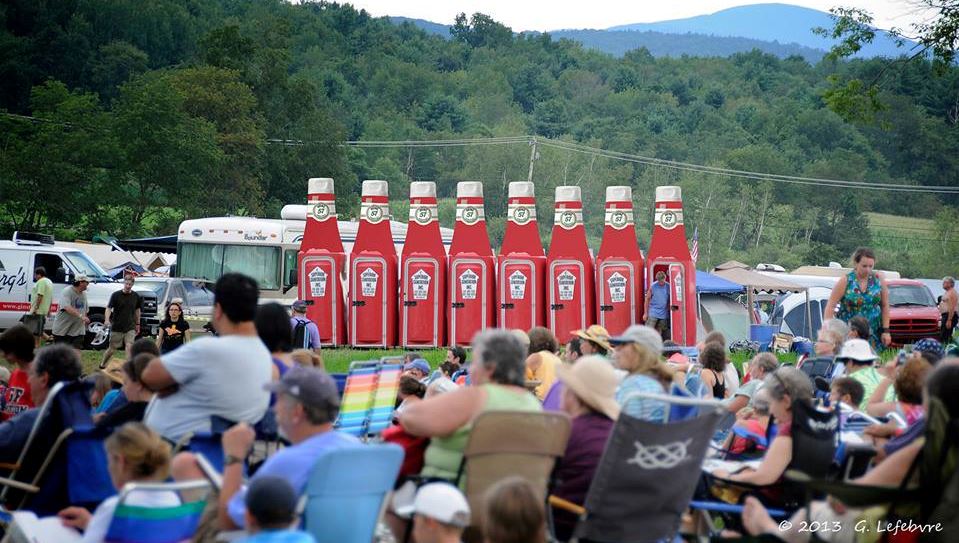
So some creative team at Heinz ketchup got the same inspiration and must have said (we hope jokingly) … “let’s do the whole Reese’s Cup thing and do a ketchup bottle port-o-john mash up!”

But it apparently wasn’t a joke.  Alas, the iconic Heinz ketchup bottle became the place that was your best friend after too many beers at the county fair.

Again, I can’t imagine that someone at Heinz somewhere might have asked the question:  “Do we really want our iconic bottle and brand to be remembered as a smelly urinal?”  “Do we want someone to look at a ketchup bottle on a table and say, ‘Hey, I remember relieving myself in something that looked just like that a couple of weeks ago!  Yum!  I’m gonna put some of that on my french fries!’”

Gives a new twist to the line about “anticipation”.

I spoke to my brother who was a former creative director at Saatchi and at Grey.  His interpretation:  desperation.  Sales and the stock price are in the toilet (pun intended).  You’re under the gun.  The CMO is about to get the boot.  The account is about to be put up for review.  These are situations where taste, decorum, and thoughtful advertising are set aside.

Throw deep.


Brain 1 – History (and Thanksgiving) 0

I’ve been plowing through a stack of books about the brain … how we process information, store it, understand it, and incorporate that information into our lives.  There’s no shortage of them.  The brain and its vagaries are hot topics, especially if you are in the behavioral marketing or communications sciences (that would be me).  I just finished a great read by Robert Burton.  It was the title that got me:

“On Being Certain:  Believing your are right even when you’re not”

Of course he wasn’t talking about you and me.  To steal the tag line from the late Senator Long, he was talking about “the person behind the tree”.  You and I … well, we’re sure we’re right.  Right?

Wrong.

Fact is, what we THINK happened in the past likely did not … at least not in the way we think.  We didn’t party as much (or as little) as we think we did in high school and college.   We weren’t as cool (or dopey) as we thought we were in our twenties.  And that summer road trip wasn’t as fun and bizarre (or mind stultingly boring) as we imagined.

Indeed … the road trip may not have even happened!

Fact is, after you finish reading Burton’s book you begin to rethink everything about what you think you know.  Because according to him a good chunk of it is something we made up along the way.

Burton explores the ‘hidden layer’ of the brain that enables us to – among other things – reinterpret history.  It is this subconscious layer that makes us certain about things that either allows us be certain about things that are either (a) dead wrong; or (b) didn’t happen.

He gives the example of Ulric Neisser‘s famous Challenger explosion study.  Ulric, a professor and psychologist, the day after the Challenger study asked his students to write down the details of that day.  Two and a-half years later he asked them again and guess what.  In a mere 30 months less than 10 percent told the same story.  A quarter of the participants told a ‘strikingly different’ story.  Most interesting was this – when shown their own original account many clung to the ‘new version’ of history.  As told by Burton:

“Many expressed a high level of confidence that their false recollections were correct, despite being confronted with their own handwritten journals.  The most unnerving was one student’s comment, ‘That’s my handwriting, but that’s not what happened.'”

I’m imagining it is why all those politicians – both left and right – say stuff about themselves that isn’t true.  Maybe it is why Rush Limbaugh and Glenn Beck have – as noted recently in the New York Times – created their own myth about the origins of Thanksgiving and the demise of American socialism and rise of American capitalism.

Doesn’t have much to do with truth.  But for them it has become their reality.  The past is metastasized, digested and recast.  And viola!  Out pops a new reality.

This is a sad reality for people like me that are in the communications business.  Every day someone can wake up and decide that they are going to change history.  Their ‘hidden layer’ is going to process the next wave of information and decide that you’re no longer cool.

Shoot, they may even decide that you are downright evil (e.g. you may have THOUGHT that those Pilgrims were nice folks yearning for religious freedom in funny hats but in reality they were communist, collectivist, fascist zealots that were only saved when unshackled from their socialist roots and given a heavy dose of capitalism and an across-the-board tax cut.)

Seems we have to work hard just to keep history the same.

Doesn’t leave much time to make for a better future.

Fact is, what we THINK happened in the past likely did not … at least not in the way we think.  We didn’t party as much (or as little) as we think we did in high school and college.   We weren’t as cool (or dopey) as we thought we were in our twenties.  And that road trip wasn’t as fun and bizarre (or mind stultingly boring) as we imagined.

Indeed … the road trip may not have even happened!

Death of a Brand

R.I.P. Pontiac.  It has gone the way of the mullet.  That was part of the problem.  Think of one and you eerily begin to think of the other.

The venerable brand that brought us the GTO, the TransAm, and many iconic V-8 muscle cars is quietly being put to rest.

What happened?  Seems to me that the Pontiac was the case of the non-adaptive brand.  Think StudebakerEdselSaturn (one of which I still own!).

pontiac logoAdaptive brands change, morph, reconfigure and adjust to the times.  They broaden their aperture and constantly develop new points of relevance.
A good — should I say ‘classic? — example is Coca-Cola.  A Coke bottle would feel just at home in a Frank deCapra movie as it would Mad Men or Jersey Shore.  It has a palette of personalities, images, and experiences that is so vast it fits in every context, every emotion, every age.  As one of its many taglines put it, “Coke is Life!”

Then there are the brands that adapt in a more sudden even violent manner.  Here are three I remember from my youth.  (BTW, my youth was a very long time ago.)

Mountain Dew.  Back then, Mountain Dew was the hillbilly 7-Up.  It was tank tops, cut off jeans and a tire swing into an Arkansas mill pond on a hot summer day.  It was syrupy with a funny yellow color.  Most of all, it was cheap.

Old Spice. That was my father’s brand.  Ironically (or iconically!) my Dad was a sailor, a Chief Petty Officer, WWII veteran and Pearl Harbor survivor.  He was a mans man.  He went to the barber shop monthly, shunned shaving creme (hot soapy water worked just fine) and was suspicious of cologne (Old Spice was an after shave).

Cadillac.  Our German-Italian neighbor in New Orleans, Mr. Doescher, drove a Cadillac.  Mr. Doescher was a devout Catholic.  He was also the head of a longshoreman’s union with shadowy wealth that combined with strong middle-class, blue collar values.  You could find him every Saturday in his t-shirt and boxers watering his lawn with a garden hose.

That was then.  Now is now.  Today all three of these brands are edgy, hip, young and very, very current.  They are X-games, retro-cool, hip-hop and — in the case of Cadillac — a dash of classic rock and roll.

For Pontiac, something got lost in the transition from the Grand Prix to the Vibe.

It stayed Smokey and the Bandit in a world of Glee and Dexter.

Rest In Peace.

Is social media small change?

The latest kerfuffle in social media circles has been Malcolm Gladwell’s recent piece in the New Yorker headlined “Small Change.”

In it Gladwell has the temerity of asserting that social media’s impact on social change is not all that it is cracked up to be.  Some of his jabs are sharp.   Like calling innovators ‘solipsists’ and saying that ‘they’ – that is the vaunted social media futurist gurus – ‘often want to cram every stray fact and experience into their new model.’

Ouch!

Gladwell’s argument is characteristically simple and trenchant – that online social networks do not engender either the strong commitment (and risk!) nor the organizational structure that make for social change.  Using the civil rights movement as an example, he notes that real change – substantive action in the face of entrenched power – is not social media or social networking’s strong suit.  Social media, Gladwell writes:

“is simply a form of organizing which favors the weak-tie connections that “give us access to information over the strong-tie connections that help us persevere in the face of danger. It shifts our energies from organizations that promote strategic and disciplined activity and toward those which promote resilience and adaptability. It makes it easier for activists to express themselves, and harder for that expression to have any impact. The instruments of social media are well suited to making the existing social order more efficient. They are not a natural enemy of the status quo. If you are of the opinion that all the world needs is a little buffing around the edges, this should not trouble you. But if you think that there are still lunch counters out there that need integrating it ought to give you pause.” (my emphasis added)

This bold assertion – that social media is just window dressing and doesn’t represent any fundamental change in how social change is achieved – has got the preachers of social media gospel in a tizzy.

One writer on MediaPost blasted back with an article eloquently entitled, “Malcolm Gladwell is Wrong, Wrong, Wrong.”

Clearly Mr. Gladwell has hit a nerve.

And in my view rightly so.  It is still early in the social media revolution.  But what we have seen to date doesn’t appear to have prompted many fundamental changes in attitudes, behavior, norms, or even public policy.

One of the better rebuttals comes from Brendan Smith and Jeremy Brecher.  In it they quibble with many of the characteristics that Gladwell attributes to past social movements.  But their main point is to remind Gladwell (and all of us) to keep a clear distinction between social media as a tool and social media as an end in itself.

“Gladwell is surely right when he says social media ‘are not a natural enemy of the status quo.’ But that is only the beginning of the discussion. The pertinent question is whether social media can contribute to the process of forming social movements and effective social action, not whether social media can substitute for that process. (A telephone system is not a PTA, but it can sure as heck be useful for getting a few hundred people out to confront the school board or vote in the school board election.)”

That is — in the JuiceBar’s view — the better way to look at this.  Social media and social networks are tools.  They are to the 21st century what the telegraph was to the 20th (although I must say that better stories came out of the events around the Pony Express than out of the building of the telegraph network.

But Gladwell’s most damning criticism is the inherent conflict that arises when information and content are ‘free’.  And that is the simple fact that sustaining value and relevance is difficult when everything is free and no one has a price to pay.

“I hate you!”

[NOTE … this post is about phones and one of my clients is Research In Motion, the maker of the BlackBerry.  This post represents my thoughts, not anyone else’s.  If anyone agrees with this it was simply dumb luck.  I never consult, advise, or otherwise communicate with any of my clients about this or any other JuiceBar post past, present or future.  And sadly, no one pays me to do this.  Just me doing my thing.  Now that I’ve made the FTC happy …]

Quick.  How many recent rivalries can you think of?

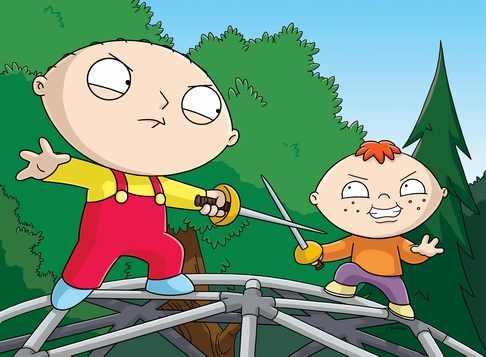
stewieLet’s check.  In entertainment there was Leno and O’Brien dust up.  In politics we recently had Cheny vs. Biden.  And in business there are those great Apple vs. Microsoft ads.  I’m a Mac!  I’m a PC!
Enter Google vs. Apple.

With a vengeance.

This is no Coke vs. Pepsi or Starbuck vs. Dunkin Donuts.

This is personal.

First there was the piece in the NYTimes about how much Google CEO Schmidt and Apple CEO Jobs hate each other.  That included reports that Jobs believes Google is the devil incarnate.

Now newly hired Google tech wizard Tim Bray claims that he indeed wants to ‘kill’ the iPhone.  In his blog, Bray writes:

The iPhone vision of the mobile Internet’s future omits controversy, sex, and freedom, but includes strict limits on who can know what and who can say what. It’s a sterile Disney-fied walled garden surrounded by sharp-toothed lawyers. The people who create the apps serve at the landlord’s pleasure and fear his anger.

I hate it.

My my.  Tell me how you really feel.

That’s a lot of hating.

It makes the Israeli-Palestinian discourse sound civil.  At least the Irish can hate each other based on centuries of history and theology.  While you may think both are assholes, at least Olberman and O’Reilly hate each other based in part on some basis in public policy and the role of government.  Even Kill Bill Uma Thurman’s hate — while excessive — had a legitimate source (torture).

But all this this vitriol?

It is about a freaking phone.  That’s right guys (and gals) … a phone.  Does phone technology merit us to rise (or sink) to the emotion of hate?  Killing?  It can’t be about the money because as best I can tell all these guys (and they are guys!) are filthy rich.

So what gives?  I suspect it is egos and marketing.

I’d note that the dictionary defines ‘bray‘ as to ‘make a loud, harsh, disagreeable sound.’

Hard to say “I hate you” and not have sound like … a bray.

Familiarty Breeds Contempt … The True Nature of Trust

There’s a buzz around a recent report by the public relations firm Edleman.  For ten long years they have invested in something they have called the “trust barometer.”  Think of it like a trust weather vane.  Where is trust going?  How strong is that wind?  Who becoming more trustworthy?  Who is becoming less?

trust1Now I’ll admit that I’m skeptical about all such research.  One reason is that I do that for a living.  I know how tricky it is to measure ANYTHING related to public opinion, much less values and beliefs.  Measuring trust is right up there with predicting the path of nanoparticles.  In fact — to carry the quantum physics analogy further — you can spend a lot of time just defining what you mean by the word trust.

But I digress.

The most recent report by the Edelman Trust Barometer is a juicy “man bites dog” story.

Amidst the growth of social networking and consumer generated content, people are trusting their friends LESS, not MORE.

Yes, you read that right.  All that money and time we spend on peer-to-peer communication has resulted in people thinking less and less of each other.

Seems that the more and better I get to know you, the more I realize that you’re not smarter than me.  You’re just another Joe.  Warts and all.

Perhaps even worse.  With all your tweets, and posts and streams I come to the startling realization that you are even MORE screwed up than I AM.  And I’m a really screwed up person!  I should know.

Because I know myself only too well, I don’t trust myself with a lot of things.  Now I’ve read your blog, your Facebook page, your Twitter stream and I’m not impressed.  I thought you had it all together.  But you sound a lot like me.  Why the hell should I trust you?

I write all this knowing people who read this blog are saying the same thing about me.  They read this and say — “who the hell is this guy?”  Why the hell am I listening to him?  I’m perfectly fine with that.

And that’s the lesson of social media.  We knew it before blogs and MySpace pages.  Familiarity can indeed breed contempt.

And that was the mistake all along.  The big myth in social media was that peer-to-peer communication would elevate everyone.  That there would be wisdom created in crowds.  That trust would emerge as we all got to know each other.

But something different happened along with way.  We didn’t change.  We remained ourselves, just with a lot more avenues to express that.  And we exposed the true nature of trust.

I don’t trust the shallow frat boy.  I don’t trust the occasional remark.  I don’t trust just any old joe just because he or she is my age and looks like me.   I don’t trust folks shilling for that latest cause.

I trust people who don’t look at me as a customer, a potential sale, or a Linked In connection.

I trust people who look at me as a person, a human being, and a friend.

Mad (and sick) Men (and women)

Anyone reading this who knows me knows this:  I’m no prude.

I like to have a good time.  I’ve had more than my share of long lunches the The Palm.  I’ve had my late nights out.  I did my time at some of the most fast-paced and well-known agencies in Washington DC.    I’m a liberal Democrat for God’s sake.

So I’m no prude.

This all by explanation of my first experience with the show MadMen.

imagesI’ve been in the communications business for 30 years.  MadMen was the show EVERYONE said I should watch.  They said it was a story that I’d relate to.  It was the archetypal lifestyle of people in our fast-paced business of creativity in a political, cunning, personal and some times tawdry business.  It was a “behind the scenes” portrayal.

As someone who has been around the block or two it was with particular interest that I watched the first two shows of the first season with my wife and daughter Saturday night.

I’m supposed to like this?  This is what people think is cool?  Fun?

It was pretty depressing to me.

There are NO redeemable characters.  All the men are misogynists.  All the women are whores.  All the clients are either idiots, sluts, or calculating sleezebags.

The protagonist — the creative “genius” — is a dour guy that spends a lot of time either drinking, smoking or shirtless in a lifeless, mechanical, and utterly amoral and loveless tryst.  Oh, and the shallowness of his relationship to his lover mirrors that of his relationship to his wife.

The “creative team” make college frat boys look like Mensa candidates.  They are sophmoric, stupid, brutish, and seemingly incapable of intelligent or ethical thought.

The female lead in the first two shows is a mousy secretary that, immediately after taking the job beds the drunken account executive (who is the chief rival to her boss ) the night after his bachelor party.  In show #2 she wonders openly to her other whore-like secretary friend why men think they have license to take liberties with women.  Even her savvyness is sleazy:  the first thing after getting the job it to get contraception, presumably so she can bed folks in the office.

And in between it all people smoke.  Men smoke in elevators.  Women smoke while pregnant.  Physicians smoke while performing an gynecological exam.  They smoke with children, in kitchens, in bedrooms, in offices, in bathrooms.

This is just in the first two shows.

I’m supposed to like this?

This is supposed to characterize the world I’ve spend half my life in?

This is me?

This is not intriguing.  This is not compelling.  This is not even entertaining.

It is embarrassing and depressing.

Maybe that is the point.